Petit Bande De Montreal - O Holy Night [CD]
All items shipped within 3 working days of payment.
Please note that all our DVDs are Region 2.
Please note that not all audio CDs are shrink-wrapped fom the factory.
O Holy Night\\Grave or na?\xbbve,spiritual or emotional, languorous or merry, all the Christmas carols of ourformer mother country are charming, exalting the true poetical expression whichreveals this people's very soul.Ernest Myrand,Quebec, 25th December 1899There is some evidencethat many of the Christmas traditions which we now practise stem from theSumerian civilisation which arose in Lower Mesopotamia more than 4,000 yearsago. This festival was closely linked to the rhythm of the seasons and withpagan songs and folk celebrations. Over time these became part of later villagecelebrations and were adopted by the early Christian church. Until a centuryago, Christmas Eve Mass and late night supper simply marked the beginning of atwelve-day festival culminating in the Celebration of the Magi (the Epiphany).It was not until the beginning of this century that Santa Claus, the Christmastree and the exchanging of gifts were introduced. The now traditional scene ofthe Christ-Child in a manger has been attributed to Saint Francis of Assisiwho, with the Pope's approval, embellished his re-creation of the Nativity withpopular Christmas carols. Although Christmas is primarily a religious festival,it is also a joyful celebration and a time for warm-hearted gatherings; whenfood, gifts and music mix with prayer. The musical repertoire that Christmashas brought about bears witness to the many different faces of this festival.In Christmas music,the popular and solemn often mix, making it difficult to trace the real originof many pieces. For example, Minuit, chretiens ('Midnight, Christians')by Adolphe Adam, the author of the famous ballet Giselle, has becomepart of the French folk tradition, although written by a professional composer.La nuit ('The Night') was also written by a professional composer,Jean-Philippe Rameau. Allons, gay, gay, berg?\xbfres ('Let us go, merryshepherdesses') was composed by Guillaume Costelley. The tune for Saintenuit ('Silent Night') is famous in many languages. On the other hand, manycomposers have also been inspired by folk celebrations and music. Around 1890,Charles Gounod published a Christmas carol in English using Henry Farnie's textBethlehem and the tune of Dans cette etable.French religious folksongs or no?\xbdls were often inspired by pastoral songs. This genreoriginated in the twelfth century as songs for the Nativity. Nevertheless, thetrue Christmas carol came from Provence and was written in this region'sdialect, often using secular tunes. These no?\xbdls or carols became fullydeveloped in the fifteenth century and soon after were compiled into books andpublished. This helped them spread in popularity thus becoming a deeply rootedtradition.The Christmas carolsin this recording are among those most frequently heard among theFrench-speaking people of Canada. Many of them came from across the Atlantic tobecome part of Quebec's regional tradition. According to the historian ErnestMyrand, 'the tune of the future ?\xe7a bergers ussemblons-nous
O Holy Night
The Night
Christmas Comes Anew
Let's Go Merry Shepardesses
Pastourelles, Pastoureaux (No\xef\xbf\xbdl Angevin)
Oh, What A Great Mystery!
So, Shepherds!
Les Anges Dans Nos Campagnes
The Sleep Of The Infant Jesus
In This Manger
Il Est N\xef\xbf\xbd Le Divin Enfant
Come My Children
What Is This Perfume So Appealing
All The People Of Ch\xef\xbf\xbdrtres
Au Saint Nau (No\xef\xbf\xbdl Poitevin)
It Was On Christmas Eve
Jesous Ahatonhia (Huron Carol)
Carol Of The Bells (Ukranien Carol)
There Is A Flower
Yule-Tide Fires
Bel astre que j'adore
O Come All Ye Faithful
Product Information
Product Information
Shipping & Returns
Shipping & Returns
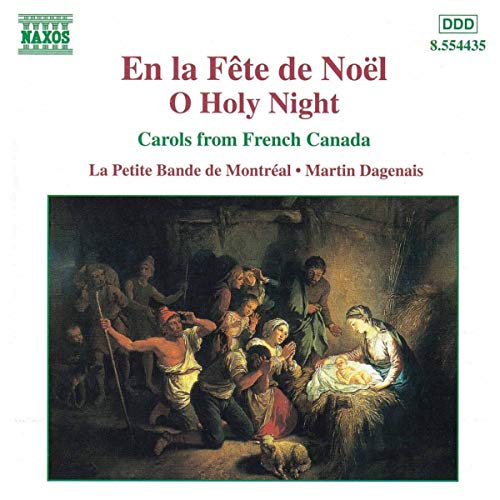
Petit Bande De Montreal - O Holy Night [CD]
Petit Bande De Montreal - O Holy Night [CD]
All items shipped within 3 working days of payment.
Please note that all our DVDs are Region 2.
Please note that not all audio CDs are shrink-wrapped fom the factory.
O Holy Night\\Grave or na?\xbbve,spiritual or emotional, languorous or merry, all the Christmas carols of ourformer mother country are charming, exalting the true poetical expression whichreveals this people's very soul.Ernest Myrand,Quebec, 25th December 1899There is some evidencethat many of the Christmas traditions which we now practise stem from theSumerian civilisation which arose in Lower Mesopotamia more than 4,000 yearsago. This festival was closely linked to the rhythm of the seasons and withpagan songs and folk celebrations. Over time these became part of later villagecelebrations and were adopted by the early Christian church. Until a centuryago, Christmas Eve Mass and late night supper simply marked the beginning of atwelve-day festival culminating in the Celebration of the Magi (the Epiphany).It was not until the beginning of this century that Santa Claus, the Christmastree and the exchanging of gifts were introduced. The now traditional scene ofthe Christ-Child in a manger has been attributed to Saint Francis of Assisiwho, with the Pope's approval, embellished his re-creation of the Nativity withpopular Christmas carols. Although Christmas is primarily a religious festival,it is also a joyful celebration and a time for warm-hearted gatherings; whenfood, gifts and music mix with prayer. The musical repertoire that Christmashas brought about bears witness to the many different faces of this festival.In Christmas music,the popular and solemn often mix, making it difficult to trace the real originof many pieces. For example, Minuit, chretiens ('Midnight, Christians')by Adolphe Adam, the author of the famous ballet Giselle, has becomepart of the French folk tradition, although written by a professional composer.La nuit ('The Night') was also written by a professional composer,Jean-Philippe Rameau. Allons, gay, gay, berg?\xbfres ('Let us go, merryshepherdesses') was composed by Guillaume Costelley. The tune for Saintenuit ('Silent Night') is famous in many languages. On the other hand, manycomposers have also been inspired by folk celebrations and music. Around 1890,Charles Gounod published a Christmas carol in English using Henry Farnie's textBethlehem and the tune of Dans cette etable.French religious folksongs or no?\xbdls were often inspired by pastoral songs. This genreoriginated in the twelfth century as songs for the Nativity. Nevertheless, thetrue Christmas carol came from Provence and was written in this region'sdialect, often using secular tunes. These no?\xbdls or carols became fullydeveloped in the fifteenth century and soon after were compiled into books andpublished. This helped them spread in popularity thus becoming a deeply rootedtradition.The Christmas carolsin this recording are among those most frequently heard among theFrench-speaking people of Canada. Many of them came from across the Atlantic tobecome part of Quebec's regional tradition. According to the historian ErnestMyrand, 'the tune of the future ?\xe7a bergers ussemblons-nous
O Holy Night
The Night
Christmas Comes Anew
Let's Go Merry Shepardesses
Pastourelles, Pastoureaux (No\xef\xbf\xbdl Angevin)
Oh, What A Great Mystery!
So, Shepherds!
Les Anges Dans Nos Campagnes
The Sleep Of The Infant Jesus
In This Manger
Il Est N\xef\xbf\xbd Le Divin Enfant
Come My Children
What Is This Perfume So Appealing
All The People Of Ch\xef\xbf\xbdrtres
Au Saint Nau (No\xef\xbf\xbdl Poitevin)
It Was On Christmas Eve
Jesous Ahatonhia (Huron Carol)
Carol Of The Bells (Ukranien Carol)
There Is A Flower
Yule-Tide Fires
Bel astre que j'adore
O Come All Ye Faithful
Product Information
Product Information
Shipping & Returns
Shipping & Returns
Description
All items shipped within 3 working days of payment.
Please note that all our DVDs are Region 2.
Please note that not all audio CDs are shrink-wrapped fom the factory.
O Holy Night\\Grave or na?\xbbve,spiritual or emotional, languorous or merry, all the Christmas carols of ourformer mother country are charming, exalting the true poetical expression whichreveals this people's very soul.Ernest Myrand,Quebec, 25th December 1899There is some evidencethat many of the Christmas traditions which we now practise stem from theSumerian civilisation which arose in Lower Mesopotamia more than 4,000 yearsago. This festival was closely linked to the rhythm of the seasons and withpagan songs and folk celebrations. Over time these became part of later villagecelebrations and were adopted by the early Christian church. Until a centuryago, Christmas Eve Mass and late night supper simply marked the beginning of atwelve-day festival culminating in the Celebration of the Magi (the Epiphany).It was not until the beginning of this century that Santa Claus, the Christmastree and the exchanging of gifts were introduced. The now traditional scene ofthe Christ-Child in a manger has been attributed to Saint Francis of Assisiwho, with the Pope's approval, embellished his re-creation of the Nativity withpopular Christmas carols. Although Christmas is primarily a religious festival,it is also a joyful celebration and a time for warm-hearted gatherings; whenfood, gifts and music mix with prayer. The musical repertoire that Christmashas brought about bears witness to the many different faces of this festival.In Christmas music,the popular and solemn often mix, making it difficult to trace the real originof many pieces. For example, Minuit, chretiens ('Midnight, Christians')by Adolphe Adam, the author of the famous ballet Giselle, has becomepart of the French folk tradition, although written by a professional composer.La nuit ('The Night') was also written by a professional composer,Jean-Philippe Rameau. Allons, gay, gay, berg?\xbfres ('Let us go, merryshepherdesses') was composed by Guillaume Costelley. The tune for Saintenuit ('Silent Night') is famous in many languages. On the other hand, manycomposers have also been inspired by folk celebrations and music. Around 1890,Charles Gounod published a Christmas carol in English using Henry Farnie's textBethlehem and the tune of Dans cette etable.French religious folksongs or no?\xbdls were often inspired by pastoral songs. This genreoriginated in the twelfth century as songs for the Nativity. Nevertheless, thetrue Christmas carol came from Provence and was written in this region'sdialect, often using secular tunes. These no?\xbdls or carols became fullydeveloped in the fifteenth century and soon after were compiled into books andpublished. This helped them spread in popularity thus becoming a deeply rootedtradition.The Christmas carolsin this recording are among those most frequently heard among theFrench-speaking people of Canada. Many of them came from across the Atlantic tobecome part of Quebec's regional tradition. According to the historian ErnestMyrand, 'the tune of the future ?\xe7a bergers ussemblons-nous
O Holy Night
The Night
Christmas Comes Anew
Let's Go Merry Shepardesses
Pastourelles, Pastoureaux (No\xef\xbf\xbdl Angevin)
Oh, What A Great Mystery!
So, Shepherds!
Les Anges Dans Nos Campagnes
The Sleep Of The Infant Jesus
In This Manger
Il Est N\xef\xbf\xbd Le Divin Enfant
Come My Children
What Is This Perfume So Appealing
All The People Of Ch\xef\xbf\xbdrtres
Au Saint Nau (No\xef\xbf\xbdl Poitevin)
It Was On Christmas Eve
Jesous Ahatonhia (Huron Carol)
Carol Of The Bells (Ukranien Carol)
There Is A Flower
Yule-Tide Fires
Bel astre que j'adore
O Come All Ye Faithful